Nuclear energy has three main phases.
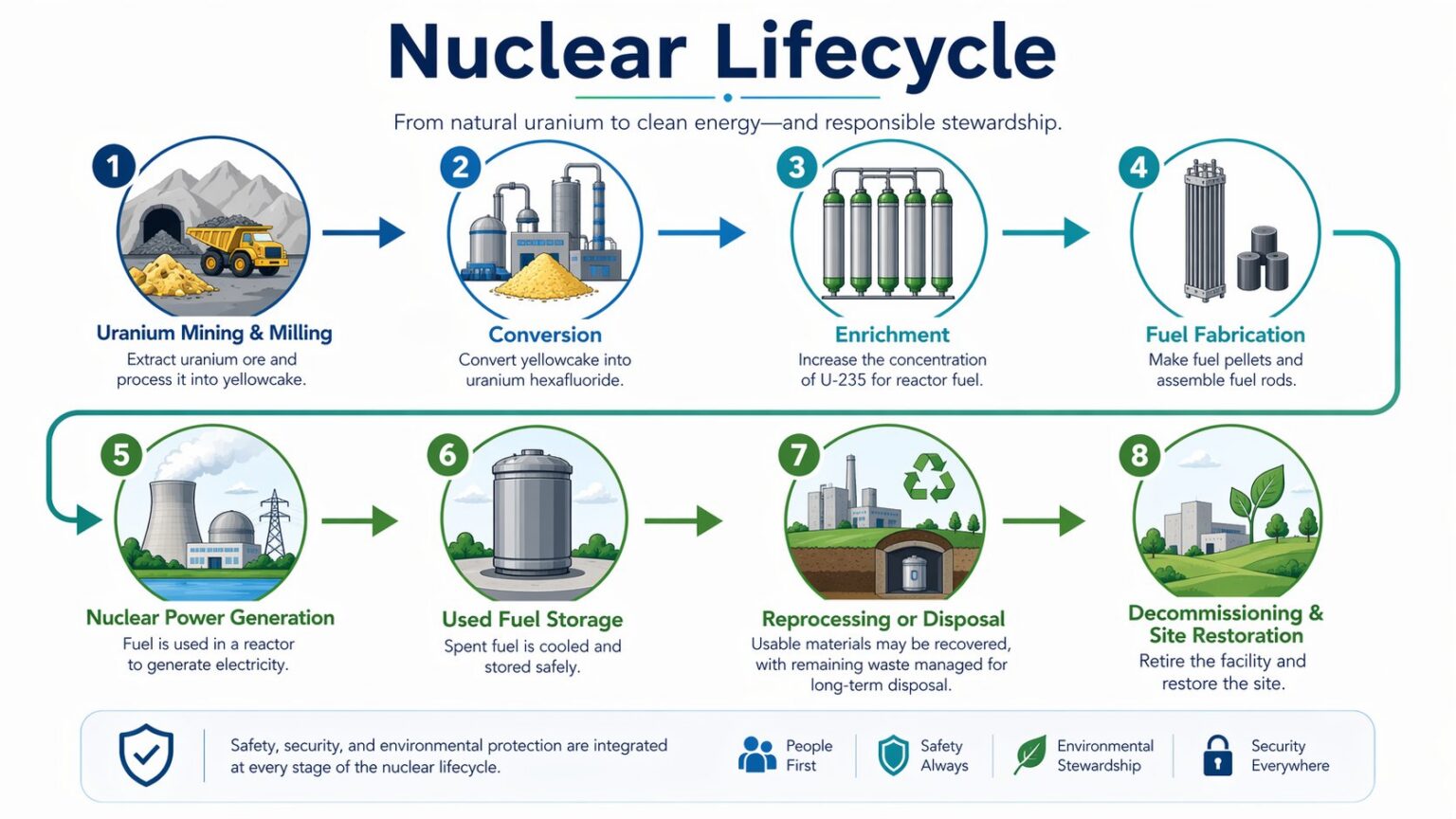
When people say “nuclear lifecycle,” they mean everything from mining uranium to disposing of waste. A campus might host some or all of these stages. Here’s how the flow works:
01
Mining & Milling
Uranium ore is extracted and processed into “yellowcake” — a concentrated uranium powder. This step is a possible campus function but doesn’t have to be on-site.
02
Conversion
Yellowcake is chemically transformed into uranium hexafluoride (UF₆), a gas that can be enriched. This is the step Tooele County has received specific interest about.
03
Enrichment
The concentration of uranium-235 is increased to make reactor-grade fuel. Most commercial reactors use 3–5% enriched uranium; advanced reactors need higher concentrations.
04
Fuel Fabrication
Enriched uranium is manufactured into fuel pellets and assemblies — the physical form that goes into a reactor.
05
Reactor Operations
Fuel is used to generate electricity or heat. Modern campuses may host small modular reactors (SMRs) or microreactors rather than large traditional reactors.
06
Storage & Reprocessing
Used fuel is stored in cooled pools, then dry casks. Reprocessing can recover usable uranium and plutonium for reuse — a key DOE focus area.
07
Waste Management & Disposal
The most sensitive step. Low-level waste goes to licensed disposal sites. High-level waste requires long-term deep-geologic solutions still being developed nationally.